When we talk about industrial 3D printing, the conversation often revolves around high-temperature materials – PEEK, PEKK, or Ultem. But what if your research points in the opposite direction? What if your application calls for a material that melts gently, just above body temperature?
Enter the Sharebot SnowWhite². While its high-temperature (HT) version can reach a scorching 350°C for advanced polymers, this machine harbors a surprisingly delicate soul. It is one of the few SLS (Selective Laser Sintering) systems specifically architected to handle low-melt thermoplastic powders – materials with melting points below 100°C, such as polycaprolactone (PCL) for biomedical use.
Here’s how the SnowWhite² transforms from a powerful industrial oven into a gentle, precision sintering tool for R&D.
The Challenge: Taming the Heat for Sensitive Powders
Low-melt polymers are incredibly sensitive. Too much heat, and they degrade. Too little, and they won’t sinter. The SnowWhite²’s standard heating profile is calibrated for high-performance materials, but using that same aggressive ramp-up on a powder like PCL would be like using a flamethrower to melt butter.
To succeed with biomedical or low-melt applications, you don’t need less precision – you need a different strategy for thermal management.
Fine-Tuning with the “Lamps Control” Plugin
Unlike conventional ovens, the SnowWhite² uses halogen lamps to heat the powder bed. The energy delivered is regulated by minimum and maximum lamp intensity settings.
For high-melt polymers, a wide range (e.g., 20%–100%) works perfectly. For low-melt materials, however, you need a gentle, gradual warm-up – ideally a single, smooth heating step.
Here’s the trick: by enabling the “Lamps Control” plugin, you unlock two critical parameters: Lamps Min and Lamps Max. These allow you to narrow the lamp’s power range, softening the thermal curve and preventing thermal shock to the powder.
The 15-Minute Rule: Thermal Equilibrium
Patience is a virtue in low-melt sintering. Once your chamber reaches the target temperature (e.g., 55–60°C for PCL), the SnowWhite² requires a stabilization phase of at least 15 minutes.
This isn’t downtime; it’s a crucial step. It ensures that every component inside the machine – from the metal frame to the last grain of powder – reaches a uniform temperature. Without this equilibrium, you risk warping or inconsistent layer adhesion.
Case in Point: Printing with Polycaprolactone (PCL)
PCL is the star of biodegradable, low-melt printing. Used for patient-specific implants, scaffolds, and drug delivery devices, it demands a narrow processing window.
On a default SnowWhite² setup, the lamp intensity might swing from 20% to 100%. For PCL at 55-60°C, that’s too aggressive.
Our R&D settings for PCL:
- Default Minimum: 20% → Adjusted to: 0%
- Default Maximum: 100% → Adjusted to: 20%
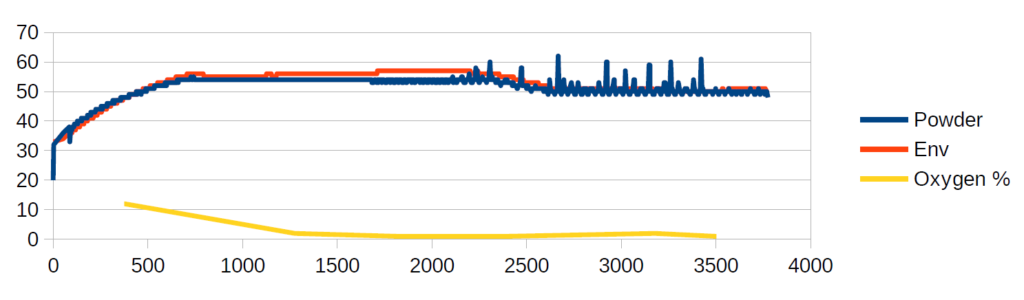
By capping the maximum lamp power at just 20%, we drastically reduce thermal stress on the powder. The result? A smooth, controlled warm-up that produces consistent, high-quality sintered parts without degrading the biomedical material.
Why This Matters for R&D
The ability to seamlessly switch from high-performance engineering polymers to low-melt biomedical powders makes the SnowWhite² a truly versatile research platform. Whether you are developing absorbable bone grafts or testing novel thermoplastic elastomers, you don’t need two different machines.
You just need the right settings.